I have met many individuals, who, having failed to obtain any improvement in the means of education in their respective places of residence, have removed to towns whose schools were good, believing the sacrifice of a hundred, or even of several hundred dollars, to be nothing, in comparison with the value of the school privileges secured for their children by such removal. Still more frequently, when other circumstances have rendered a change of domicile expedient, has this principle of selection governed in choosing a residence.I don't think I can understand that without understanding more about public education in MA at that time. How many towns had schools? What percentage of the child population attended them, and what were their economic characteristics? Were they a trendy municipal feature like highways in the fifties or streetcars today, or did they have deeper community roots? It's an interesting quote either way.
- Fifth Annual Report to the Board of Education of Massachusetts, 1842
Tuesday, February 28, 2012
Horace Mann describes "White Flight"... in 1842
From a text on the social underpinnings of education (picked up on whim), a selection from Horace Mann.

Monday, February 27, 2012
Emergency Rooms
Last week Kaiser ran a Phil Galewitz story on for-profit hospitals that were screening emergency room patients. Patients deemed to have non-emergency conditions were required to make a pre-payment, as much as $150 in HCA's case.
This week Kaiser noted a Wall Street Journal article on a Washington state Medicaid plan to stop reimbursing emergency rooms for providing non-emergency treatment.
Is there a meaningful difference between these policies? For-profit corporation and state program alike, they both utilize financial incentives to prevent emergency rooms from being used for non-emergency care. They demonstrate the point that rationing care isn't really optional, it is already happening.
What is optional is how much discretion and transparency we allow in the process of rationing. The for-profits and Washington are opting for rote standards where care givers have no flexibility in distinguishing what care is necessary (and reimbursable) from what is not. Contrast that with Oregon's CCO plan, which goes the opposite way in trying to find savings by empowering providers. I don't know which approach will prove the better, but I know which one I'm rooting for.
Sunday, February 26, 2012
A question for Representative Conger
The CCO bill was finally passed, but the Exchange bill is still in a holding pattern. The Lund Report caught a powerful statement by Representative Jason Conger (R-Bend), talking about the CCO bill (emphasis mine):
After listing many of those complaints about the legislation, Rep. Jason Conger (R-Bend) said “to do nothing is simply unacceptable,” adding that “it required leadership” to get the bill to the House floor for a vote.
“I don’t mean the twisted, pathetic concept of leadership that values political positioning and partisan gain over good policy,” he said. “I mean real leadership, to do the hard work that is required to address big issues that matter to Oregonians who are not in this building, to the rest of the state besides us. There is risk involved in passing this bill. But I believe that I know I was sent here to address those kinds of problems—like jobs, and yes, healthcare…despite the risk in the bill, I will be voting yes.”I'm impressed to see someone buck party for conscience in the way Conger did, especially because passage of the CCO bill was a near certainty once it came to a vote. He could have just voted for it and held his peace, as 22 (of 30) other Republicans did. Saying what he did took guts... So why tolerate the stonewalling on the Exchange bill? If Conger thinks people sent him to the legislature to work on the problem of health care, how is spiking the Exchange bill part of the solution?
Wednesday, February 22, 2012
Gender and Transit continued
I've been searching for any materials discussing gender issues and transit. I haven't found anything Portland specific yet, but this post from a Seattle blogger pointed me to this study, part of a project called "Gendered Innvoations".
The GI study was mostly about how traditional metrics don't capture the full usage of transit by women because they are more likely than men to "chain" their trips, making multiple stops on the same excursion. Because of the mismeasurement, transit agencies risked over emphasizing commuter service in ways harmful to women. That's interesting, but not what I'm after.
The GI study also Included a chart showing women consistently utilizing public transit at higher rates than men, across ethnicity, I wonder how it looks when you break it down by income or age. People who have no choice will use public transit, that isn't saying anything interesting. What I'd like to know is, are there gender differences in how people who have a choice decide between driving and alternate transportation?
The most helpful part of the paper was a footnote describing safety improvements at stops and stations, referencing Schulz et al., 1996. That reference is to this paper, Women and Transit Security: A New Look at an Old Issue. It includes a history of efforts to safeguard women on public transit, beginning with attempts (that failed) to reserve the last car on New York Subway trains for women only, and other more successful ventures:
Also, are there any more recent studies that follow up on this issue?
The GI study was mostly about how traditional metrics don't capture the full usage of transit by women because they are more likely than men to "chain" their trips, making multiple stops on the same excursion. Because of the mismeasurement, transit agencies risked over emphasizing commuter service in ways harmful to women. That's interesting, but not what I'm after.
The GI study also Included a chart showing women consistently utilizing public transit at higher rates than men, across ethnicity, I wonder how it looks when you break it down by income or age. People who have no choice will use public transit, that isn't saying anything interesting. What I'd like to know is, are there gender differences in how people who have a choice decide between driving and alternate transportation?
The most helpful part of the paper was a footnote describing safety improvements at stops and stations, referencing Schulz et al., 1996. That reference is to this paper, Women and Transit Security: A New Look at an Old Issue. It includes a history of efforts to safeguard women on public transit, beginning with attempts (that failed) to reserve the last car on New York Subway trains for women only, and other more successful ventures:
Those familiar with Progressive Era concerns about white slavery know that creation of such groups as the Traveller’s Aid Society were directly related to demands that women be present in train stations to protect young women, often runaways or working-class immigrants, from the clutches of those perceived as ready to lure them into lives of prostitution. Early policewomen, too, spent much of their time patrolling train stations, with the expressed aim of saving women from the perils believed awaiting them there. Thus concern about women and their safety in and around transit systems has a long history and plays an important role in women’s demands for public positions in both the social service and criminal justice fields.The description of the Traveller's Aid Society strikes me as very relevant to Portland today, and the concept that women's entry into law enforcement and public transit are connected is interesting in a different way, but neither is what I'm after right now. What I'm after is this reference included in the Schulz paper,
S. Rosenbloom and E. Burns, Do Environmental Measures and Travel Reduction Programs Hurt Working Women? (Tucson, AZ: Roy P. Drachman Institute for Land and Regional Development Studies, 1993)Sadly, that paper appears to be really, really hard to get. But I found a review of it, which helps (emphasis mine):
Rosenbloom and Burns looked at surveys of workers conducted as part of employers' efforts to reduce solo driving by their employees in Phoenix and Tucson, Arizona in 1990 and 1991. They discovered that women, especially women with children, are more or as likely as men to be solo drivers and that women take longer to get to work despite their shorter commute distances.
The authors hypothesize that women with children and domestic duties use cars more because they find alternatives such as buses unsafe and impractical. The surveys did not ask respondents about "linked trips" (stopping at daycare on the way home from work), but the authors suggest that linked trips explain women's more time-consuming travel and their preference for solo driving. They offer the anecdote of the woman who worked across the street from her home but reported that it took her 15 minutes to get to work, because she had to first drive her children to daycare.
Rosenbloom and Bums assert that working mothers (about one third of women surveyed) will be hard hit by trip reduction programs aimed at reducing solo driving. "Many women will continue to drive," the authors suggest "accepting new expenses [financial penalties for solo driving], because driving still costs less than the additional child or eldercare needs created by longer commutes, or because they cannot obtain the needed care, or because they must use the time to conduct their domestic responsibilities, or because they cannot find or do not feel safe taking public transit Other women will change modes, but at some cost to the well-being of their families."So they observe the same phenom noted in the GI paper about chaining trips, but connect it to what I think is a very logical preference for auto transport even without the safety issues. The review concludes with this summation, again with my own emphasis:
While this report suffers from its authors' biases--they believe that the car is the best all around transport mode, that transit is unlikely to conquer the suburbs, and that "bicycling is largely a male mode," apparently not for women--their basic point needs to taken seriously by the environmental community. If working mothers' concerns are ignored, the road/auto lobby can claim that environmentalists care more about the earth than about women and children. Let's prove them wrong.Are we proving them wrong, Portland?
Also, are there any more recent studies that follow up on this issue?
Tuesday, February 21, 2012
Gender and the City
Two recent posts in the O highlight the absence of gender in the Portland urbanization discourse. A story on the increase in biking revealed the fact that men outnumbered women 2 to 1 among bicyclists. And a letter to the op-ed page lamenting the absence of free parking included this passage:
By removing four blocks of free, albeit unsafe, parking, the number of available spaces within walking distance of my apartment has been cut in half. Think about the implications for safety and work schedule: For a woman who returns from work after dark, it does not appeal to abandon a car under the I-405 bridge.That the cost of parking should be increased is an axiom among urbanists, but how often do you see an acknowledgement that walking, biking, or taking public transit as opposed to driving poses different trade-offs for different genders? Do urbanists have anything more to say to women concerned with the safety implications of abandoning the car beyond, "Grin and bear it"?
OSPIRG and ineffective medicine
I was struck by an op-ed relating OSPIRG's efforts to open up the rate review process in Oregon. OSPIRG working in concert with DCBS brought rate review before the public in a big way. That is certainly a good thing. But how good? The trouble is, the individual and small group markets were already pretty well regulated:
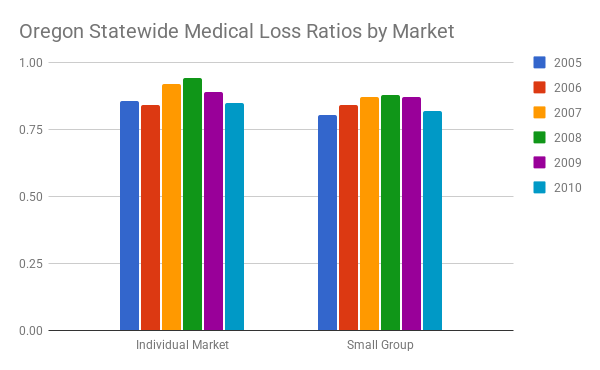 Notice the horizontal axis crosses the vertical at 80%. To be clear, the medical loss ratio is the portion of premium going to medical bills. The portion above the medical loss ratio is production expense, admin and profit. That insurance portion of premium is what OSPRIG is gunning for, they've said nary a word about the money on the medical side, where the vast bulk of the dollars go.
OSPIRG's efforts are further limited in that the review process they're promoting is limited to individual and small group markets. In the latest Health Insurance in Oregon report those two groups total 36% of the private market. Which is to say, among Oregonians who have private insurance for every one who might be helped by these efforts there are almost two who will not.
Combining the market distribution with a lowball MLR pick of 80% and you get this:
Not as ineffective as Republicans when it comes to health care reform, but it sure does leave room for improvement.
OSPIRG's efforts are further limited in that the review process they're promoting is limited to individual and small group markets. In the latest Health Insurance in Oregon report those two groups total 36% of the private market. Which is to say, among Oregonians who have private insurance for every one who might be helped by these efforts there are almost two who will not.
Combining the market distribution with a lowball MLR pick of 80% and you get this:
Not as ineffective as Republicans when it comes to health care reform, but it sure does leave room for improvement.
Saturday, February 18, 2012
Real Tort Reform
I don't have time now to do a full write-up of what I think tort reform should look like and why, and to my surprise I discovered I don't need to. I guess I'm not the first person to think that a workers comp style process is applicable to Medical Malpractice. Closer to home, I found that Jack Roberts had written about this very concept back in 2009 in the O (emphasis mine):
 ALAE are expenses that can be directly attributed to a specific claim. So the cost of a court filing for instance is particular to a claim while the cost of a claims department generally is not. In practice, for these lines ALAE is mainly defense counsel.
What these figures show is that from 2003 to 2010 only half of the med mal premium dollars went to indemnity payments to claimants. The rest was chewed up by defense costs, overhead and profit. In contrast only 13% of the Workers Comp premiums were diverted in this way. The difference is even more striking when you realize med mal claims are much more likely to have a plaintiff's attorney involved than workers comp, and they are paid from indemnity proceeds. So not even half of the med mal premium money actually reaches patients suffering harm.
A lot of ink has been spilled on the extension of a tort cap, but I think all of the above shows that we need to ask a deeper question. Does the way we've structured Medical Malpractice liability make sense? As our experience with Workers Compensation shows, alternate structures exist that have far less costly processes for adjudication.
Other proposals are more specific to medical malpractice, such as specialized health care courts and safe-harbor practices to protect doctors from liability even if something goes wrong. But maybe it's time to consider a more radical reform, such as a system of no-fault insurance for medical malpractice similar to the workers' compensation system.To get a sense of how much more efficient workers comp is at delivering benefits than med mal, let's look at Oregon state wide experience:
Since the adoption of workers' comp laws early in the last century, workers injured on the job are covered without regard to whether the injury was caused by the negligence of the employer, a co-worker, the worker himself or simply bad luck. Injured workers have their medical bills and other out-of-pocket costs covered as well as receiving compensation for loss of income and certain general damages in accordance with an established schedule. In return, they give up the right to bring an individual lawsuit against their employer and with it the hope of winning a lottery-size award or settlement.
Applied to medical malpractice, such a system would compensate any patient whose surgery or other treatment (or lack of treatment) resulted in an adverse result, whether or not the doctor, hospital or nurse was at fault. It could redirect resources currently spent finding fault to compensating patients who have been harmed. And it would recognize that even where medical providers have performed their jobs badly, large jury verdicts are not paid by the wrongdoers but shared by everyone through the insurance system.
What these figures show is that from 2003 to 2010 only half of the med mal premium dollars went to indemnity payments to claimants. The rest was chewed up by defense costs, overhead and profit. In contrast only 13% of the Workers Comp premiums were diverted in this way. The difference is even more striking when you realize med mal claims are much more likely to have a plaintiff's attorney involved than workers comp, and they are paid from indemnity proceeds. So not even half of the med mal premium money actually reaches patients suffering harm.
A lot of ink has been spilled on the extension of a tort cap, but I think all of the above shows that we need to ask a deeper question. Does the way we've structured Medical Malpractice liability make sense? As our experience with Workers Compensation shows, alternate structures exist that have far less costly processes for adjudication.
Subscribe to:
Posts (Atom)