Showing posts with label urbanization. Show all posts

Saturday, December 7, 2013

Hollywood Micro Apartments- what exactly is the problem?

Micro-apartments continue to draw opposition, particularly the Hollywood location. Why?

Street-parking near the Hollywood location is already at capacity, it's extremely rare to see open spots.  And because of the configuration of the highway and Sandy Blvd there are no nearby neighborhoods that would absorb parking by new residents.  Given that, what difference could new residents make?  There's no such thing as negative parking spaces, street parking can't be more full than it is now.  I get the distinct impression neighborhood concerns are not about parking, but about other things.

A recent letter from the Hollywood Neighborhood Association Board printed in the Hollywood Star reinforces that impression, emphasis mine:

Imagine the effects on your neighborhood if small, single-family homes on standard 50-by-100-foot lots were replaced by 64-foot tall apartment buildings that housed 70 or more people stuffed into 56 dormitory-like units with no parking.  Imagine further that the buildings' tenants were temporary with no connection to each other despite its so-called "group living" designation.  Imagine no dorm proctor to keep things from getting out of hand.  It is easy to anticipate noise problems, even worse parking problems than we've already experienced from no-parking apartments…
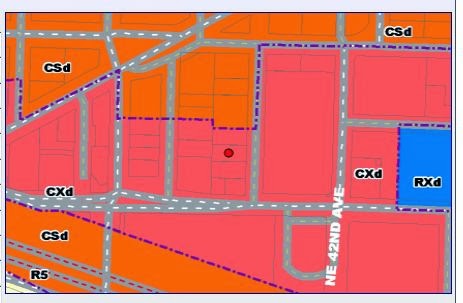
Never mind the false insinuation that the block in question is for single family homes when in reality it is surrounded by commercial property and highway, and zoned CX intended for intense development.  And never mind the hand-wringing over the plight of people "stuffed" into dormitory like units since no one will be there except by choice, meaning without that choice they'll be somewhere worse. 

 Look instead at the concerns:  The residents will be noisy and temporary, they won't have a proctor.  Those concerns have nothing to do with parking, and everything to do with fears and preconceptions about potential new residents.

If residents of the new buildings create noise problems or "get out of hand," whatever that means, then it should be addressed via law enforcement just as it would be if they lived in a single family home.  And yeah, people in single family homes do get out of hand and we find a way to cope and the world goes on.  But do we prohibit construction of new single family homes because their residents might be criminals?  How is that any more rational with apartments?

People should be judged on what they do, not on where they live.  It is shameful when we do otherwise.

Saturday, November 30, 2013

Portland's problem with density


Portland has a problem with dense development.  The problem is that we are too willing to reject it, whether because we're enamored with what we have or afraid of what is new.  That mix of complacency and xenophobia will in my view doom efforts to build and sustain a livable city if it goes unchecked.

One problem is suburbs.  When we don't accommodate people living in the city, we force them into suburbs.  By their nature such areas are vastly more car-centric, and its citizens car-dependent.  Disproportionate population growth there will, through democracy, lead to a more car-centric public policy.  Highways instead of streetcars, more space devoted to parking instead of retail or other human use.  We can't force most of the metro population into an environment antithetical to livability without inviting blowback.

Another problem is economics.  What happens when you increase the desirability of something, but not its supply?  Prices go up.  And in Portland, housing prices go up a lot.  Despite the bubble, housing prices have increased more than 60% since 2000 as measured by the Case-Shiller index.  How many households have seen their income grow by 60% over this time?

Inflationary housing prices mean the city will be accessible only to an ever smaller, wealthier class.  That compounds the public policy problem (why should poorer suburbanites accept policy dictates that cater to urban elites?), and it reduces Portland's diversity.  Cities thrive on diversity and the interplay of different ideas that come from different backgrounds and experiences.  That dynamism creates jobs.  Restricting housing in the city will push out not only people, but creativity and job creation.  How livable is a city without those?

Here is a litmus test for Portlanders.  Take the number of years you've been living in your house and imagine someone born that many years after you.  Suppose this hypothetical person grew up in a similar environment as you and made similar choices about education, family, and career.  Would they now have the same ability to move into a city neighborhood, not necessarily the same neighborhood but one with comparable amenities, as you did years ago?  Extending the idea, I'd say a community which by design bars our children from doing and living as we do cannot be called sustainable. 

It isn't enough for livability to be a good idea, an affectation that we put on like a fancy hat.  To mean something in the real world it has to be able to grow.

Saturday, May 18, 2013

Pearl District and Housing

The Oregonian published a modest story highlighting the economic diversity of the Pearl District, a well known urban renewal project.  I was surprised at how many negative comments the story drew.  Apparently it tweaked some people's noses to learn that poor people can live in the Pearl.

There are a lot of reasons to like or dislike urban renewal, but let's look at the most basic consequence.  Urban renewal added housing.  Between 2000 and 2010 the two census tracts which most match the Pearl added more than 5,000 units of housing.  And it didn't add it willy-nilly, it was concentrated within an area of 0.72 square miles, most of it reclaimed from industrial and commercial use. 

Now consider what would happen without such concentrated development.  5,000 units equals 50 100-unit apartment buildings.  Given the problems the east side has shown accepting multi-unit housing, how would nimby leaders feel about 50 additional big buildings heading their way?  Or you could suppose that demand would have been met with suburban housing.  Assuming the same housing density as Beaverton that would require developing over 1,500 acres of land.

There are only so many ways of dealing with a rising population and a corresponding demand for housing.  Urban renewal has its flaws, but if you don't allow multi-family housing in existing neighborhoods and you don't want sprawl then reclaiming land from other uses (and the subsidies that go with it) is what is left. 

Thursday, May 31, 2012

Followup on Hollywood

Last year I shot some photos around the Hollywood Theater, trying to understand why people were concerned about the aesthetics of putting an apartment building next door.  The new building isn’t finished, but it’s far enough along to get a sense of the visual impact. Below are side by side comparisons, with the first shot from July of 2011 and the second from May 2012 while construction is in progress.

I still don't get what the fuss was about. The only view negatively impacted was the middle shot from the east side of Sandy around 41st street. I think the apartment building actually improves the view from the west side.

Wednesday, February 22, 2012

Gender and Transit continued

I've been searching for any materials discussing gender issues and transit.  I haven't found anything Portland specific yet, but this post from a Seattle blogger pointed me to this study, part of a project called "Gendered Innvoations".

The GI study was mostly about how traditional metrics don't capture the full usage of transit by women because they are more likely than men to "chain" their trips, making multiple stops on the same excursion.  Because of the mismeasurement, transit agencies risked over emphasizing commuter service in ways harmful to women.  That's interesting, but not what I'm after.


The GI study also Included a chart showing women consistently utilizing public transit at higher rates than men, across ethnicity, I wonder how it looks when you break it down by income or age.  People who have no choice will use public transit, that isn't saying anything interesting.  What I'd like to know is, are there gender differences in how people who have a choice decide between driving and alternate transportation?

The most helpful part of the paper was a footnote describing safety improvements at stops and stations, referencing Schulz et al., 1996.  That reference is to this paper, Women and Transit Security: A New Look at an Old Issue.  It includes a history of efforts to safeguard women on public transit, beginning with attempts (that failed) to reserve the last car on New York Subway trains for women only, and other more successful ventures:
Those familiar with Progressive Era concerns about white slavery know that creation of such groups as the Traveller’s Aid Society were directly related to demands that women be present in train stations to protect young women, often runaways or working-class immigrants, from the clutches of those perceived as ready to lure them into lives of prostitution. Early policewomen, too, spent much of their time patrolling train stations, with the expressed aim of saving women from the perils believed awaiting them there. Thus concern about women and their safety in and around transit systems has a long history and plays an important role in women’s demands for public positions in both the social service and criminal justice fields.
The description of the Traveller's Aid Society strikes me as very relevant to Portland today, and the concept that women's entry into law enforcement and public transit are connected is interesting in a different way, but neither is what I'm after right now.  What I'm after is this reference included in the Schulz paper,
S. Rosenbloom and E. Burns, Do Environmental Measures and Travel Reduction Programs Hurt Working Women? (Tucson, AZ: Roy P. Drachman Institute for Land and Regional Development Studies, 1993)
 Sadly, that paper appears to be really, really hard to get.  But I found a review of it, which helps (emphasis mine):
Rosenbloom and Burns looked at surveys of workers conducted as part of employers' efforts to reduce solo driving by their employees in Phoenix and Tucson, Arizona in 1990 and 1991. They discovered that women, especially women with children, are more or as likely as men to be solo drivers and that women take longer to get to work despite their shorter commute distances.
The authors hypothesize that women with children and domestic duties use cars more because they find alternatives such as buses unsafe and impractical. The surveys did not ask respondents about "linked trips" (stopping at daycare on the way home from work), but the authors suggest that linked trips explain women's more time-consuming travel and their preference for solo driving. They offer the anecdote of the woman who worked across the street from her home but reported that it took her 15 minutes to get to work, because she had to first drive her children to daycare.
Rosenbloom and Bums assert that working mothers (about one third of women surveyed) will be hard hit by trip reduction programs aimed at reducing solo driving. "Many women will continue to drive," the authors suggest "accepting new expenses [financial penalties for solo driving], because driving still costs less than the additional child or eldercare needs created by longer commutes, or because they cannot obtain the needed care, or because they must use the time to conduct their domestic responsibilities, or because they cannot find or do not feel safe taking public transit Other women will change modes, but at some cost to the well-being of their families."
So they observe the same phenom noted in the GI paper about chaining trips, but connect it to what I think is a very logical preference for auto transport even without the safety issues.  The review concludes with this summation, again with my own emphasis:
While this report suffers from its authors' biases--they believe that the car is the best all around transport mode, that transit is unlikely to conquer the suburbs, and that "bicycling is largely a male mode," apparently not for women--their basic point needs to taken seriously by the environmental community. If working mothers' concerns are ignored, the road/auto lobby can claim that environmentalists care more about the earth than about women and children. Let's prove them wrong.
 Are we proving them wrong, Portland? 

Also, are there any more recent studies that follow up on this issue?

Tuesday, February 21, 2012

Gender and the City

Two recent posts in the O highlight the absence of gender in the Portland urbanization discourse.  A story on the increase in biking revealed the fact that men outnumbered women 2 to 1 among bicyclists.  And a letter to the op-ed page lamenting the absence of free parking included this passage:
By removing four blocks of free, albeit unsafe, parking, the number of available spaces within walking distance of my apartment has been cut in half. Think about the implications for safety and work schedule: For a woman who returns from work after dark, it does not appeal to abandon a car under the I-405 bridge.
That the cost of parking should be increased is an axiom among urbanists, but how often do you see an acknowledgement that walking, biking, or taking public transit as opposed to driving poses different trade-offs for different genders?  Do urbanists have anything more to say to women concerned with the safety implications of abandoning the car beyond, "Grin and bear it"?

Thursday, January 5, 2012

Green Castle Wins

Green Castle won their land use appeal against BDS over the zoning decision that shut down the cart pod.  Some notable points:

-  The Hearing Officer rejected the 1987 neighborhood action plan as mostly irrelevant:
[what should be considered is] the character of the neighborhood as it exists today, not how it may be envisioned in the future by an adopted area plan. For this reason, the Hearings Officer disagrees that the Kerns Neighborhood Action Plan can be a criterion for approval in analyzing whether the proposed food court fits into the residential character of the surrounding neighborhood. Such area plans, however, can constitute some evidence of the existing character of the neighborhood and provide an indication of whether an adjacent residential area will remain residentially zoned over time. Here~ the 1987 Kerns Neighborhood Action Plan, which is admittedly outdated, indicates that the residentially zoned lands near the subject property are likely to remain residentially zoned at least into the near future. Other than that, the area plan is not very helpful in this analysis.
Do you know what your neighborhood action plan is?  Do you know who wrote it?  Are you comfortable with someone making any decision of consequence based on it?  Score one for common sense!

-  The officer then goes back to Websters Dictionary(!) to get a working definition of "residential character".  Based on that,
it is reasonable to read the concept of"residential character" as used in 33.25S.0S0.B.2 to mean the distinctive quality of the place where people dwell and live. For this reason, the Hearings Officer concludes that for the purposes of complying with 33.25S.0S0.B.2, the "residential character of the * * * R zoned area" cannot be determined solely by looking to the zoned use of the residentially designated buildings in the vicinity of the nonconforming situation. As described more fully below, it is reasonable to examine the residential area's  proximity to other uses such as existing commercial uses to determine the "character" of the residential area, and to determine whether the appearance of the proposed change in the nonconforming situation conflicts with that character. 
Score TWO for common sense!  You can't understand the character of a neighborhood without actually looking at... the neighborhood.  The whole neighborhood, warts and arterial traffic and other zoning uses and all.

- Finally, the officer acknowledges that neighborhood opinion should matter:
...the analysis is not as dependent on definitional limits as BDS Staff seems to conclude, but is determined primarily by substantial evidence. Here, the preponderance of substantial evidence strongly supports the Appellant. At the hearing, several parties submitted uncontroverted testimony that the "appearance" of the commercial parking lot before the food carts arrived was very undesirable. Those parties stated that illegal camping, litter, and illegal dumping were occurring and that the parking lot had an unkempt look. In contrast, the parties described the food court, while it was in operation, as clean, well kept and well lit. Their testimony indicated that illegal dumping and camping had ceased, and that the food court generally had a pleasant appearance.  The Hearings Officer views this testimony as substantial evidence that the appearance of the food court is considered a benefit or amenity to the surrounding residential area.
And he hits the trifecta!

The appeal finding pretty much refutes everything that made the initial BDS decision so bad.  Voices of today should count while those from 1987 should not.  Boundary lines that exist only on zoning maps shouldn't be taken to arbitrarily limit what constitutes a neighborhood.  Cheers to the Hearings Office and Green Castle!

Monday, January 2, 2012

Suburbs vs. the City

In commenting on a recent editorial, I tried to highlight what I think is a serious blind spot in popular notions of urban planning and sustainability.  In Portland, much thought and effort is directed at "livability."  Few of those efforts though are targeted at families, and in fact measures such as the composting program seem intended to push families out.  I wanted to put some numbers on migration, so I looked at the 2009 ACS data.  I compared figures for the city of Portland to the Portland-Vancouver-Beaverton MSA minus the city of Portland, taking the latter group as an approximation for suburbs.

The data tells an interesting story.  Series 1101 gives total households, families, and families with children under 18 split into three subsets:  Families with children under 6, families with children both under and over 6, and families with all children 6 or older.
At the outset there is an obvious difference in the number of households reported as "families", unsurprisingly singles tend to be attracted to the city.  And at first glance there isn't much difference between city and suburbs when it comes to how many families have kids, 46% vs 49%.  The net result is that suburban households are significantly more likely to have children, one third vs less then a quarter in the city.

Things get weird when you get into the age groups.  The percentage of households with young children is very close, only half a point separates city and suburb.  The difference is concentrated in families with older children:
Now some might construe this as evidence of a shift in preference, that newer parents are more comfortable raising kids in the city and its only a matter of time before the figures for households with older kids come into line. So I looked at 2005 ACS data:

This pattern isn't new.  What it speaks to is a transition, that as children age families are more likely to pack up and move out of the city.  How many people are we talking about?  If Portland had the same share of families with older kids as it has of families with younger kids it would mean an extra 13,355 families.  Averaging that over 18 years and it comes out to 742 families per year.  That's 742 families who tried living in the city, put up with it for at least 6 years and then decided to do something else and embraced suburban car culture.  Each year.  That was the status quo.

Now think about the composting program and how the city gave the functional equivalent of a raised middle finger when people asked what they were supposed to do with diapers.  How many more families will boogie off to the burbs?  The city has a grace period because families are trapped by the rotten housing market but that won't last forever.  Eventually families will regain a choice in housing, and no one should be surprised when they act on it. 

How sustainable is a vision of the city that drives families out into the suburbs?

Wednesday, December 28, 2011

Development and Taxes

Random statistics:  The property tax payoff for the SE 28th and Burnside condos.  An old greasy spoon Chinese restaurant on the corner of Burnside and 28th was torn down to make way for condos in 2009.  How much value did this create?

I'll use a real simple first order approximation and look at property taxes.  The figures are online at Portlandmaps.com.  The 32 condo units have a 2011 tax totaling $138,997 or an average of $4,344 per unit.  That's about 10% more then the average tax paid by the rest of the non tax-exempt property owners on the block, who actually own land!  To put those numbers in concrete terms, look at the map:

Now you might think there is something wrong with that block, maybe the land use is particularly ill-conceived and atypical.  So I rolled up the taxes on the block south as well.  That block had an even lower average tax, a few points below the Burnside block the condos sit on.  Here is a total view:
So that little sliver of condos pays almost as much in taxes as the rest of the two blocks combined.  To put it another way, the condo development almost doubled the tax revenue coming from the two blocks.

Who benefits from the taxes?  Pretty much everyone.  It is money for schools, the city, the county, and just about every other local municipal agency.  Even the greasy spoon came out better off.  And best of all it was accomplished without coercion, but by just staying out of the way and letting change happen.  Keep that in mind the next time you hear about a development proposal.

Tuesday, December 20, 2011

Memory and the Future

This piece by Ryan Avent displays a rare sense of humility  in admitting how difficult it is to imagine the future and how our descendants might judge us.  To participate, consider how you think about the past, and in particular the decisions made by our predecessors.  Do you lament or celebrate the widespread adoption of the automobile, or the industrial development that polluted so much of our environment, or...  anything?  The sad truth is we think little about the past at all, the world is what it is and we try to make the best of it.

This is part of what I dislike about preservationism, the idea that we should preserve structures so that future generations can enjoy them.  Who knows what future generations will enjoy or value or need?  Think about BDS shutting down the Green Castle cart pod in part because a neighborhood planning document written in 1987 didn't contemplate food carts.  1987!  That's only 24 years ago, yet I have absolutely no idea, interest, or even desire to know what people back then thought except as a purely historical concern.  How much less compelling would be the ideas and intentions of people from fifty years ago, or a hundred?

Preservation doesn't save the past so much as it foists the present whether people want it or not.   Implicit is the belief that the way things are now is the best that they could ever be, and that any change would necessarily be for the worse.  It is narcissism writ large.

Thursday, December 15, 2011

Happy Ending in Hollywood

I'm glad Creston Homes found a way around neighborhood opposition to build on the empty lot next to Hollywood Theater.  Success came from giving up early on working with the Design Commission and neighbors.  The article quotes a project manager with the developer (emphasis mine),
“It had a lot to do with the fact that anyone in the neighborhood could file an appeal of any decision (of the design commission), for a small fee,” he said.
Such appeals, [the project manager] noted, could have derailed the project.
The commission’s design review process also could have been longer, he said. And that would have made a huge difference because city building permit fees increased on July 1. Because the team applied before fees increased, [the project manager] estimates that it saved $56,000. The permit for construction was issued Nov. 17.
Anyone can appeal anything for any reason, at low cost.  Even if the appeals are eventually rejected by the Design Commission that can drag out the review process for months.  That by itself is enough to kill projects.  The net result is a regular review track heavily weighted towards preserving the status quo, even when that means keeping an empty lot at an address with a walk score of 92 in an area targeted for major transit infrastructure.  As a city with dreams of growth and density Portland needs to do better.

Thursday, December 8, 2011

Different stick, same horse

Beating the same horse as yesterday, here's a WW story on problems in the Portland rental market.  The elephant in the room is that most of the inner east side is reserved for single family housing.  Planners have sort of acknowledged the incongruity between their density goals and the infrastructure on hand, but the only solution they've posed is granny apartments.  They are nuts if they think that is a solution, if people don't want to live in their mom's basement why would they want to live in some other mom's basement?  And on the owner side if people can afford to buy a single family home in the city why would they take on the infrastructure cost and liability of creating a separate unit in exchange for low end rent?  Even in this puff piece they cite $1,200 per month in rent- exactly the high end niche that is already amply served.

The reality is that if Portland wants to encourage high population density it needs high density housing.  What exists  on much of the inner east side isn't it.

Wednesday, December 7, 2011

Followup on Irvington

The new issue of the Hollywood Star has further reporting on problems between the Irvington Community Association (ICA) and the city over the Historic Preservation District.  The story is worth reading in its entirety, but sadly is not available online as far as I can tell. The gist of it is that there are two issues:
  • The current fee schedule represents a "doubling" of cost per the ICA
  • The ICA is dissatisfied with what actions trigger review and what do not.
No offense, but buyer beware.  By doing what it did the ICA voluntary subjected Irvington to the whims of the city's review process and its expense.  There is no exception in the city code that says review will follow exactly what the ICA wants at exactly the price ICA thinks appropriate.  That point is obvious, and it should have been obvious to everyone involved last year.  But focusing on the ICA misses the real culprit, which is evident in a parallel story about the Buckman neighborhood's pursuit of its own historic register listing.

Per the Buckman story the only way a register listing can be opposed is if a majority of property owners send a notarized letter of opposition.  Read that twice- they aren't saying a majority of people who write in, but an absolute majority of all property owners have to send notarized letters opposing the designation to shut it down.  That burden is so insurmountable that the state doesn't even include the possibility in its process flow chart.  It's a process so slanted to produce an "approval" it would make union organizers blush.

No wonder the Irvington listing passed, there was no way it couldn't.  The process doesn't imply real consent, it is designed to provide a fig leaf of consent while passing the listing.  I'd expect to see something like that in a history of Jim Crow South, not living in the flesh in my state government.

This brings me back to a quote in the original posting on Portland Architecture,
[an architectural historian and Irvington Preservation Committee member] said the Portland currently counts 5,277 buildings either in historic districts or individual landmarks on the National Register – all of which require design review for exterior alternations.
That list could grow substantially in the future. Citizens are either gathering data for potential historic districts in the Buckman neighborhood and are investigating that option in at least two others.  Under  national historic standards, [the historian] said 85 percent of buildings in North and Northeast Portland west of 82nd Avenue could qualify as eligible for historic protection.
Much of inner Southeast Portland is basically of the same vintage, so potentially the entire inner east side could be put off limits to development.  How does that square with the urban growth boundary, which demands urban infill?  How does that square with Oregon's property tax limits, which demand redevelopment in order to sustainably fund city services?  How does that square with the premise that the Portland metro population will double in the next 30 years?  There is a serious disconnect here...

Sunday, November 27, 2011

Irvington Historic District: Buyers Remorse

I guess some people didn't know what they were signing up for when Irvington applied for Historic District status.  Take a look at the fees applicable.  "Minor Projects" like changing the house color or adding exterior lights now costs $1,050, just to pay the city to think about whether or not it will allow the homeowner to proceed.  I can understand why people would be upset, but how did they not know what they were signing up for?  It's not like the city just created the fee schedule, this is what Irvington residents elected to do to themselves. 

I can laugh now, but I'll be downright pissed if they get the fees reduced and I wind up having to subsidize their nonsense.

Saturday, November 12, 2011

POW: Alex Steffen

LSE hosted Alex Steffen for a discussion of where the world in general and cities in particular are going.  I thought the most interesting take was the concept that what will save us is better data.  He talks about how everything from how we drive (mileage meters) to how we use power or water will eventually automatically record data and then give us information- how do we do compared to average?  How are we doing compared to yesterday or the year before?  To me it is a profound example of tech making what was once arbitrary and irrelevant into something specific and purposeful- changing how we use the gas and break pedal to be more efficient, connecting actions with consequences.

There is a downside though, in that the process of converting data into knowledge is not value free.  Someone has to determine what the average is and how it should be calculated, someone determines the scales on which we judge ourselves.  For example with utilities is the relevant average per household or per person?  For vehicles should they be judged by class (hatchbacks separate from SUV’s) or all together?  Those questions establish norms for society, but because of their “back room” nature it is unlikely people will be aware of them or the values embodied in their selection.  It’s analogous to what insurers do in developing classification plans, except that if people don’t like the way an insurer classifies them it’s easy enough to find a different insurer.  Not so with society…

Saturday, October 29, 2011

Women and the City

One of the angles I don’t see covered enough in public discussions of urban living is gender.  For instance, the desirability of standing alone in the dark at a bus or train station may change markedly depending on who you ask.  I’d expect that to filter down to residential choices, that women faced with income constraints would be more likely to move out until they found affordable housing rather then stay in and accept the trade-off in neighborhood quality.

Here in a roundabout way is empirical evidence.  The MTO study didn’t show the educational effects for children its authors were looking for, but it did find significant health benefits for women who moved out of high poverty neighborhoods to those with low poverty.  In essence better neighborhoods are healthier neighborhoods for women in a way that doesn’t apply to men.

Worth considering for a region like Portland with specific goals for densification and urbanization.